





 Science
 About
About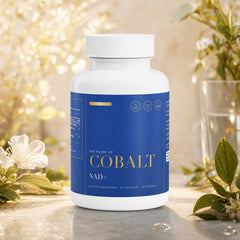
Longevity, explained
NAD+ 101.
The molecule your cells run on, explained in plain English.
01 / What it is
A courier molecule in every cell
NAD+ stands for nicotinamide adenine dinucleotide. It is a coenzyme, a small helper molecule, found in every living cell in your body. Think of it less as a single ingredient and more as a courier: it shuttles back and forth, carrying the electrons that everyday cellular reactions depend on.[1]
Your cells make NAD+ continuously, from the food you eat and from a handful of building blocks called precursors. It takes part in hundreds of reactions, and it is especially busy inside mitochondria, the compartments often called the cell's power plants, where it helps turn nutrients into usable energy.[6]
Because it sits at the center of so much routine cellular housekeeping, from energy handling to the activity of enzymes called sirtuins, researchers keep circling back to it.
Gold points trace NAD+ at work inside the mitochondria. Illustrative, not to scale.
02 / Why it declines
Why levels tend to slip over time
Across human and animal studies, one pattern comes up again and again: tissue NAD+ tends to trend downward as the years add up.[2] Part of that is simple demand. Everyday life keeps drawing on the same pool. Tap each card below to see what researchers point to.
This is general education about normal physiology, not a promise. NAD+ is one piece of a much larger picture of healthy aging that also includes sleep, movement, and nutrition. These statements have not been evaluated by the Food and Drug Administration.
03 / What supports it
NAD+ or a precursor: when each makes sense
You can give your cells the raw materials they use to make NAD+, and there is more than one route. The two most common choices are the coenzyme itself and a precursor such as NMN. Neither is a shortcut around your own biology. They simply meet the pathway at different points.[4]

| NAD+ (ours) | NMN | |
|---|---|---|
| What it is | The finished coenzyme, delivered directly | A precursor the body converts along the pathway toward NAD+ |
| Per serving | 500 mg NAD+, plus two polyphenol partners | 500 mg NMN, single ingredient |
| Serving | 2 capsules daily | 1 capsule daily |
| Good fit if you | Prefer the coenzyme itself, paired with plant polyphenols | Prefer a clean, single-ingredient precursor |
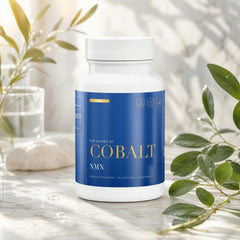
Want the single-ingredient route instead? See our NMN, or compare the full lineup in the ingredient library.
04 / Why ours
Nothing hidden, printed on every label
Plenty of formulas hide behind a proprietary blend. Ours does not. Here is exactly what two capsules deliver, every milligram of it, and why each one earns its place.
| Ingredient | Per serving | Why it is in the formula |
|---|---|---|
| NAD+ Nicotinamide Adenine Dinucleotide | 500mg | The coenzyme itself, supplied directly so your cells receive the finished molecule rather than only a building block. |
| Quercetin Dihydrate Sophora japonica, flower bud | 250mg | A plant flavonoid included as an antioxidant partner that rounds out the formula alongside the coenzyme. |
| Japanese Knotweed Extract Polygonum cuspidatum, root | 150mg | Standardized to 98% resveratrol, a polyphenol that is among the most studied compounds in cellular-aging research. |
Other ingredients: HPMC (vegetable capsule), microcrystalline cellulose, brown rice flour, olive oil, silicon dioxide, magnesium stearate. Serving size 2 capsules. 30 servings per container. Full Supplement Facts appear on every label.
Third-party tested
Checked by independent labs for identity and purity.
Clinically studied forms
Ingredient forms that appear in published research.
Transparent dosing
Every milligram printed on the label, no blends.
Made in cGMP facilities
Produced under current Good Manufacturing Practice.
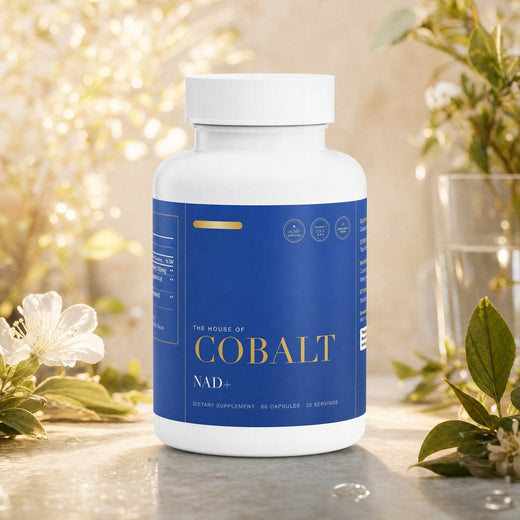
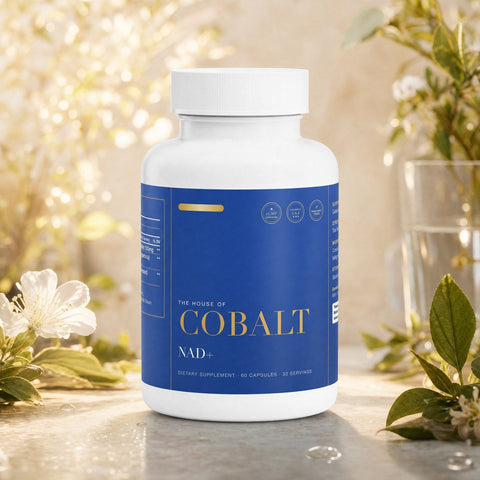
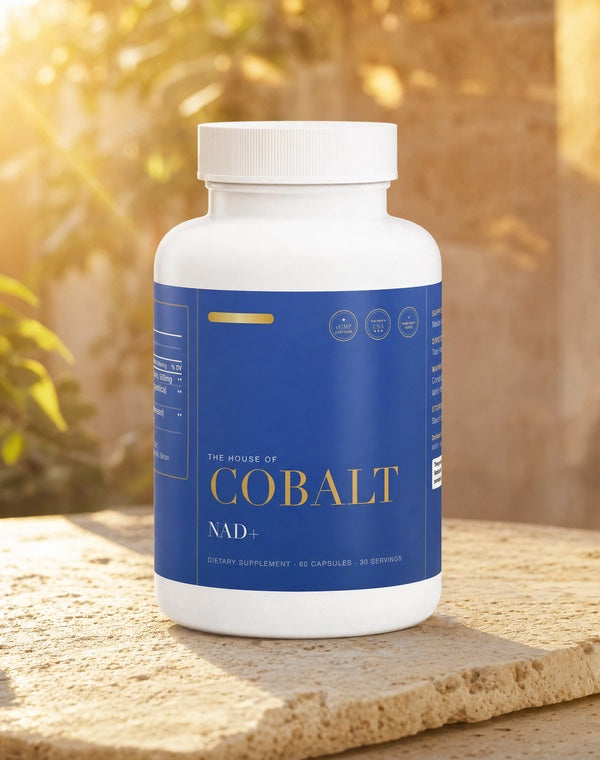
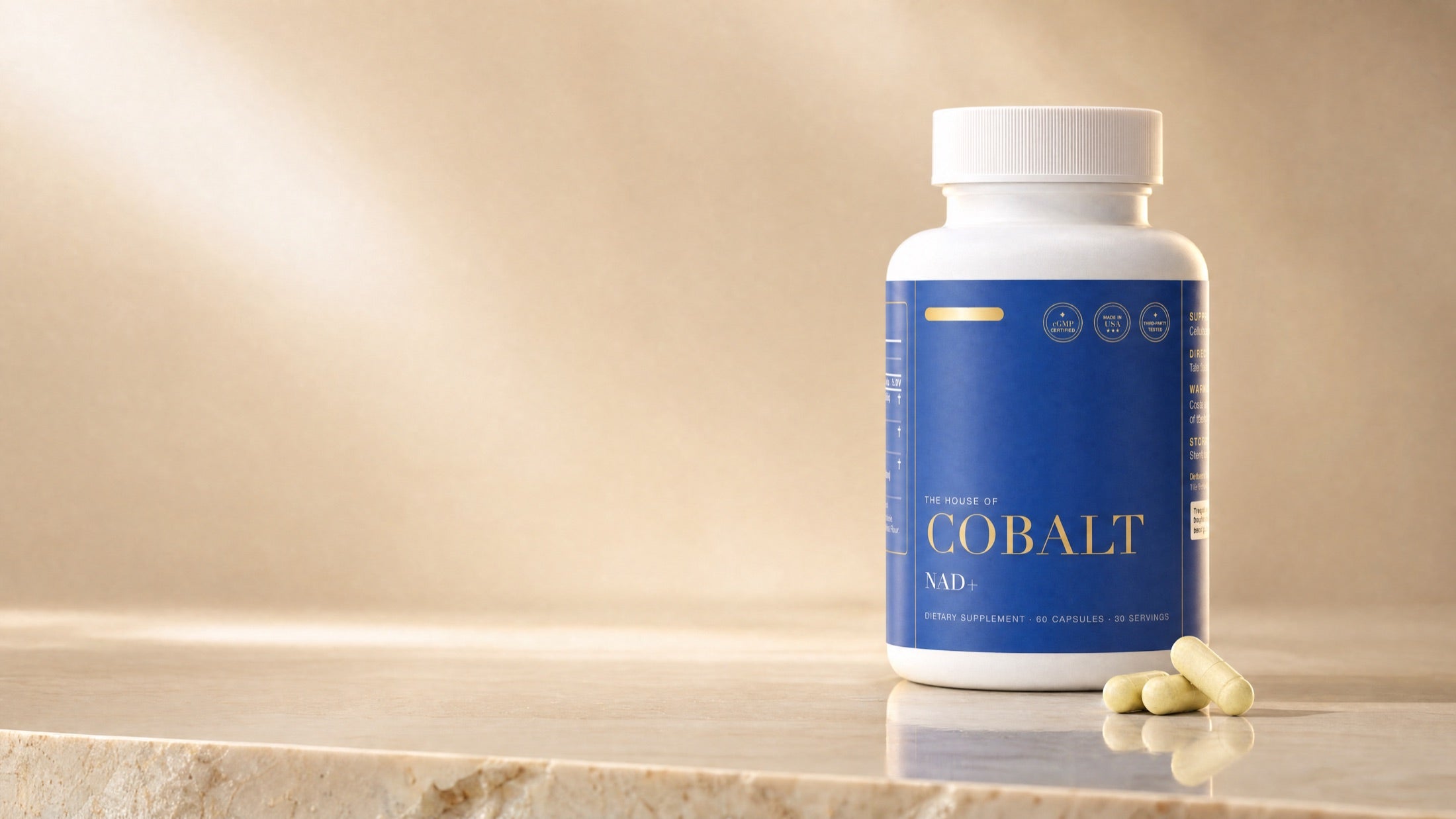
House of Cobalt NAD+
The coenzyme itself at 500 mg, with quercetin and resveratrol-standardized knotweed. A transparent, one-month formula.
These statements have not been evaluated by the Food and Drug Administration. This product is not intended to diagnose, treat, cure, or prevent any disease.
05 / FAQ
Common questions
When should I take it?
Many people take NAD+ in the morning as part of a daily routine. The label suggests two capsules daily. Consistency, taking it around the same time each day, tends to matter more than the exact hour. If you are unsure how it fits your schedule, ask your healthcare professional.
With food, or on an empty stomach?
Either works for most people. The label suggests taking the two capsules with about 6 oz of water. Some prefer taking it with a meal if they find capsules sit easier that way. There is no strict requirement, so pick the option you will remember.
NAD+ or NMN, which is right for me?
They meet the same pathway at different points. Our NAD+ delivers the coenzyme itself plus two plant polyphenols, while NMN is a single-ingredient precursor the body converts toward NAD+. If you like the idea of the finished molecule with antioxidant partners, start with NAD+. If you prefer one clean ingredient, look at NMN. Neither replaces a balanced diet and sensible habits.
How long until it feels like part of my routine?
Supplements are meant to be taken consistently over time rather than as a quick fix. Most people find that a daily NAD+ capsule settles into their morning within the first couple of weeks, simply as a habit. Everyone is different, and this is about routine, not a promised result.
References
- Covarrubias, A. J., Perrone, R., Grozio, A., & Verdin, E. (2021). NAD+ metabolism and its roles in cellular processes during ageing. Nature Reviews Molecular Cell Biology, 22(2), 119 to 141.
- Verdin, E. (2015). NAD+ in aging, metabolism, and neurodegeneration. Science, 350(6265), 1208 to 1213.
- Massudi, H., Grant, R., Braidy, N., Guest, J., Farnsworth, B., & Guillemin, G. J. (2012). Age-associated changes in oxidative stress and NAD+ metabolism in human tissue. PLoS ONE, 7(7), e42357.
- Yoshino, J., Baur, J. A., & Imai, S. (2018). NAD+ intermediates: the biology and therapeutic potential of NMN and NR. Cell Metabolism, 27(3), 513 to 528.
- Rajman, L., Chwalek, K., & Sinclair, D. A. (2018). Therapeutic potential of NAD-boosting molecules: the in vivo evidence. Cell Metabolism, 27(3), 529 to 547.
- Cantó, C., Menzies, K. J., & Auwerx, J. (2015). NAD+ metabolism and the control of energy homeostasis: a balancing act between mitochondria and the nucleus. Cell Metabolism, 22(1), 31 to 53.